
Growing Sustainability
As American cities continue to erode due to infrastructural decay and underfunding, public leaders are finally beginning to address the issues of sustainable living and accountable government in public forums. Those in positions of power who continue to ignore these topics should take note. This generation faces a number of serious problems that could easily turn America into a second-tier economy much more quickly than the uninformed might suspect. We must develop innovative solutions to deal with the repercussions as quickly as possible.
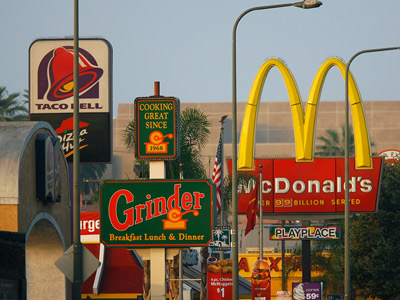
Food Desert — Original Image from HowStuffWorks.com
One major challenge confronting America is limited access to nutritious foods in poor urban and rural communities, a phenomena known as the “food desert.” Although many of us have never heard of the term, we’ve all seen food deserts and know what they are, even if we’ve only just driven by them. In fact, anywhere from 18.3 to 52.5 million Americans live in the midst of urban desolation. Instead of cacti and sagebrush, these areas host miles-long stretches of liquor stores and fast food restaurants, with few fresh vegetables or fruits to be found without traveling a fair, and sometimes impossible, distance.
Proper nutrition and our ability to access healthy foods has finally become an important part of political platforms on a national level because Americans are spending increasingly more money on obesity-related health care. For instance, healthcare costs relating to obesity reached a staggering $190 billion in 2012. Still, true change must begin from dedicated community effort. Colorado Springs, Colorado acts as a microcosmic sampling of problems cities all over America face regarding healthy and sustainable food sources. As lovely as Colorado Springs is, with access to wilderness, a fantastic atmosphere, clean air, and amazing scenic vistas, many residents find access to nutritious foods difficult. Because of the city’s sprawling geography and demographics, nearly everyone lives in the midst of a food desert, where supermarkets are more than 1/2 a mile away from home in urban areas and 10 miles away in rural areas.
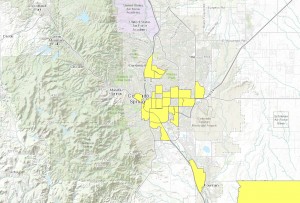
Below, a series of maps created from census data clearly illustrates the abysmal conditions regarding low access to fresh food. In the first image, the areas highlighted in yellow represent census tracts where residents either have low vehicle access or live 20 miles away from the nearest supermarket. Access the USDA’s Food Atlas to view the different maps available based on 2010 Census Data.
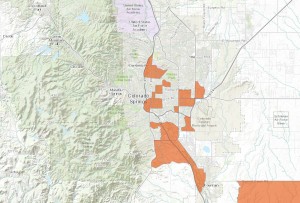
In the second image, areas in dark orange represent census tracts where a significant number of residents reside 1 mile (urban) or 20 miles (rural) from the nearest supermarket.
In the third image, the areas in light orange represent low-income census tracts where a significant number of residents are at least 1/2 a mile (urban) or 10 miles (rural) away from the nearest supermarket.
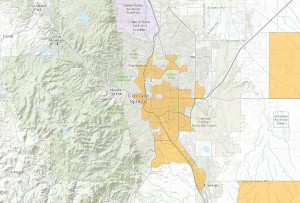
The final image combines the three maps to give a clear picture of the state of food access in Colorado Springs.
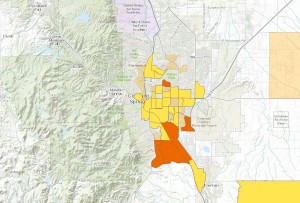
As one can see from these images, the wide distances between home and food can create real problems for low-income families because the nearest grocery store is often inaccessible on a regular basis. This means that families cannot simply walk to the local grocery store and pick up fresh fruit or vegetables on a weekly basis. Instead, families must visit the supermarket sparingly and invest in groceries that will last anywhere from two weeks to an entire month. Such foods lack nutritional value and often include preserved and processed foods.