
USR: By the Consent of the Governed
Navigation
  • Home
  • About
    • USR Updates
  • Perspective for Hire
  • Opinion
  • Analysis
  • News
  • Posting and Membership
    • Analysis Submissions
    • Opinion Submissions
    • News Submissions
  • One Good Paragraph
  • Poetry
  • Fiction
  • Creative Nonfiction
  • Contests
    • First Place
    • Second Place
    • Third Place
  • Education
    • Writing Skills Videos
    • Analysis Videos
USR: By the Consent of the Governed
You are here: Home › Opinion › Lab-Grown Meat: Your Dinner of the Near Future
← Website Redesign
The Fun Ship →

Lab-Grown Meat: Your Dinner of the Near Future
August 22, 2013 | Filed under: Opinion

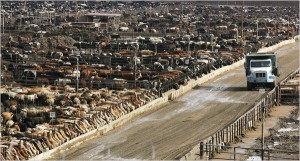
Meat Factory Cow Herd

Modern technology has made food cheaper, more transportable, pathogen resistant, and even amusing. Still, many manufactured foods contain little nutritional value, and produce markets around the globe continue to become increasingly geographically homogeneous. Food industrialization creates an ongoing slew of ethical dilemmas regarding animal health and wellness. Micro technology may provide solutions once only possible in science fiction; accordingly, recent research suggests that cell culturing may eliminate the need for factory meat farms altogether.
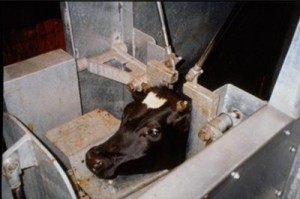
Cattle Restrained for Slaughter

Cattle Restrained for Slaughter

Recent media coverage reveals the ugly truth. Industrial meat production causes harm to the animals and the environment. Animals in factory farms live in unprecedentedly bad conditions. Almost 80% of America’s antibiotics are fed to livestock, largely because of the crowded, unsanitary conditions in which the animals live. Many of these farms allow young cattle dehorning, castrating, and branding without anesthetic. Additionally, industrial meat manufacturing has many negative environmental impacts. According to a Stanford study, the increase in global meat production will mainly “come through industrialized animal production systems.” The UN’s Food and Agricultural Organization claims that “livestock sector growth has been a prime force in deforestation . . . overgrazing” and “greenhouse gas concentrations.”
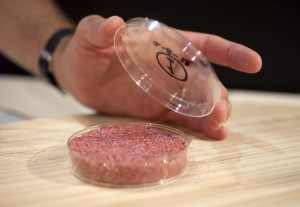
Cultured beef hamburger patty.

This reality troubles many, yet our technologies may offer a key to safe meat production and consumption. On Monday, August 5, 2013, the world’s first lab-grown hamburger was publicly cooked and eaten. This marks a real milestone in food science, one that may affect humanity significantly in coming years. Many have compared both 3D printing technologies and lab-grown meat to Food Replicators and Protein Re-sequencers from Star Trek. Star Trek fans have more reason to rejoice over Maastricht University’s Cultured Beef Project, one that’s been all over the news. Meat culturing has the potential to make human life better and more ethically sound, thereby staying true to the Star Trek-ideal of science.
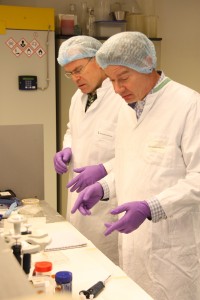
Post and Verstrate in the beef lab.

The Maastricht team, headed by Mark Post, produced the first lab-grown hamburger by culturing tissue. Post’s team safely extracted muscle tissue from the shoulder of a cow. They isolated muscle fiber, a type of cell known as a myocyte, and cultured the cells. Culturing is the process by which biologists nurture and grow cells in controlled conditions. The myocytes then fused back into muscle tissue and grew around a round scaffolding to give the tissue shape, and the Maastricht team electrically stimulated the tissue to make it contract and develop.

The business and scientific communities both seem excited by Maastricht’s results. Google’s co-founder Sergey Brin was a huge backer of the Cultured Beef Project. He and the Maastricht team spoke mainly about the practical applications of meat culturing, which they hope will eliminate the need for commercial meat production in factory farms. Post seems optimistic about the prospects of cultured meat to end the mistreatment of livestock. In a press-release interview, he stated his hope that

Twenty years from now, in a supermarket, you would have two products that were identical. One is made from an animal. It now has this label on it that “animals have suffered or been killed to make this product. . . and it is bad for the environment.” And it’s exactly the same as an alternative product made in a lab that tastes that same, has the same quality, has the same price. . . .
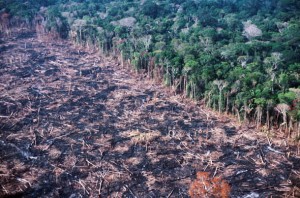
Amazon rain forest abuts newly-cleared land in Rondonia state, Brazil September 1988. Deforestation creates room to graze cattle or to plant crops, although Amazon land is inherently not ideal for farming. After one harvest, the land is no longer arable, and more land must be cleared by burning. (Photo by Stephen Ferry/Liaison)

Cheap, prevalent cultured meat would also have many environmental benefits. Almost ten percent of greenhouse gases in the U.S. come from agriculture, with livestock as the major culprit. Manure waste releases a lot of methane gas (as does, I’m not joking, cow belching). Methane’s potency as a greenhouse gas exceeds that of CO2 by twenty times. In addition, much of the deforestation of the Amazon is simply in order to grow feed for livestock.

Additionally, meat grown in labs would have great benefits for agriculture and resource conservation. Ken Cook estimates that 1,500 gallons of water go into the production of every pound of beef produced. And that’s a fairly conservative guess. Producing a loaf of bread takes a tenth that much water. Additionally, 70% of arable lands are used to grow feed for livestock. Such land could be reallocated towards feeding the hungry, and farmers could stay in work. So in-vitro meat will have a lot of important impacts.

Experiments with meat culturing currently require a lot of money and resources. Growing meat quickly and inexpensively will be the key to getting it on the market. One challenge involves finding an inexpensive growth medium for the cells. Post told the Daily Mail that certain kinds of meat, like steak, would require a blood vessel-like devise to properly deliver oxygen and nutrients to the cells. Bioreactors also cost a lot of money. The hope is that as with most technologies, the meat culturing process will continue to grow cheaper.

So how does the lab-grown burger taste? Food researcher Hanni Rutzler said, “The taste itself was as juicy as meat can be, but different. It tastes like meat, not a meat substitute like soya or whatever.” The journalist Josh Schonwald said that there’s “a leanness to it, but the bite feels like a conventional hamburger.” He concluded that “it wasn’t unpleasant.” Not exactly rave reviews, but a good first step.

Using this process will allow people to eat more exotic meats guilt-free. The ancestors of cows and chickens were both first domesticated 8,000 years ago in Asia, and their popularity today springs partially from their preexisting availability and domesticity. But our ties to history may begin to loosen, allowing us to eat any kind of meat we can grow. Perhaps we’ll see the popularization of cultured tiger meat. Some daring people may adventure to eat cultured human meat or even meat grown from their own cells. This technology has the potential to revolutionize the human-meat relationship. In the near future, many may look forward to eating a lab-grown panda burger.

Did you like this article? Share it with your friends!

Tweet
avatar

Written by Kyle York

Kyle York studied philosophy and creative writing in school. Now he tutors English and writes essays and short stories on the side. He especially likes philosophy and pop culture analysis.

← Website Redesign
The Fun Ship →

Perspective for Hire

  • An Exclusive Interview with Colorado Lt. Governor Joe Garcia
    An Exclusive Interview with Colorado Lt. Governor Joe Garcia

    Joe Garcia, the Lieutenant Governor of Colorado, has been engaged in academic oversight and guidance for quite some time, having served as President of Pikes Peak Community College Read more →

  • Build It Downtown, and Sky Sox Fans Will Come
    Build It Downtown, and Sky Sox Fans Will Come

    “Is this Heaven?” “No, it’s Iowa.” Most any baseball fan will immediately recognize the quote above from the iconic movie Field of Dreams. Remember when Read more →

News

  • The West Nile Virus Remains an Unwelcome Visitor
    The West Nile Virus Remains an Unwelcome Visitor

    Despite its relative obscurity, the West Nile Virus still poses a potential threat to nearly anyone in America, which means its origins and evolution need to be understood. The West Nile Virus is carried by Read more →

  • White Tattoos Are In
    White Tattoos Are In

    Over the past few years, a new style of tattoo has made an appearance in the ink world. Specifically, the artist still creates a shape or design, but instead of using black or various colors Read more →

  • In Memory of Seamus Heaney, 1939-2013
    In Memory of Seamus Heaney, 1939-2013

    Digging Between my finger and my thumb The squat pen rests; snug as a gun. Under my window, a clean rasping sound When the spade sinks into gravelly ground: My father, digging. I look down Read more →

Opinion

  • Time to Hit a Home Run in Downtown Colorado Springs
    Time to Hit a Home Run in Downtown Colorado Springs

    The controversy surrounding the proposal to relocate the Colorado Springs Sky Sox’s stadium has become a misguided battle between perception and reality. The impression many citizens seem to have is that Mayor Steve Bach is a puppet of some very Read more →

  • The Blight of Young Adult Fiction
    The Blight of Young Adult Fiction

    Getting booed by a class of thirteen-year-old girls only required four words from me: “I didn’t like Twilight.” The clamor subsided once I launched into some logical reasons behind the choice: Bella is a poor Read more →

  • Lab-Grown Meat: Your Dinner of the Near Future
    Lab-Grown Meat: Your Dinner of the Near Future

    Modern technology has made food cheaper, more transportable, pathogen resistant, and even amusing. Still, many manufactured foods contain little nutritional value, and produce markets around the globe continue to become increasingly geographically homogeneous. Food industrialization Read more →

Analysis

  • Guessing the Fate of the Cosmos
    Guessing the Fate of the Cosmos

    The hope that humanity will one day expand beyond its solar system, drift in space on self-supporting vessels, and explore other planets is almost universal. The theme occupies a central place in science fiction. We Read more →

  • Silk Road’s Closure: An Impactful Hit on the Illegal Drug Market
    Silk Road’s Closure: An Impactful Hit on the Illegal Drug Market

    As you have probably already heard, the FBI recently seized and closed down the notorious black market Internet site “Silk Road,” along with its creator, twenty-nine year old Ross Ulbricht. While many law-and-order types gathered Read more →

  • Meme’s the Word
    Meme’s the Word

    The scientific revolution spawned by The Origin of Species is now morphing in ways Charles Darwin himself might not have expected, as the principles of adaptation and natural selection are manifesting themselves in fields far removed from biology. Most notably, when applied Read more →

Like US on Facebook!

Login

  • Register
  • Lost Password

One Good Paragraph

  • A Decent Sunrise

    Sunrises matter. They smooth the edges and let us know that the previous day should be continued or forgotten. They tell us to take care of ourselves and those around

  • UFO Traces

    Over 300 billion stars populate our galaxy, and our galaxy is just one of another 100 or more billion galaxies, so the universe must be teeming with intelligent life. Given

Poetry

  • Caladesi Island
    Caladesi Island

    Not five minutes after we embarked on the inland path, our eyes watchful for rattlesnakes amid yellow cactus-flowers, the vampires invaded. We wondered about malaria, remembered the repellant lying on Read more →

  • “Consultants”

    They actually get paid for what they do, busily marking up giant sheets of Post-it and ripping them off to slap on the conveniently broad swathes of bland wall space. Read more →

  • Close to the Brane

    Severed and lush, transplanted dream, the violet rhythm of words not serving, having spoken the universe into existence, spacetime, dreamtime. Read more →

  • Starstuff

    The infinite is no longer Than a slice of sky that slipped, Stealthy, behind the apple of your eye. The universe gifted me with insignificance, And no matter how grateful Read more →

Follow US on Twitter

My Tweets

Get Our RSS Feed

RSS Feed RSS - Posts

RSS Feed RSS - Comments

Top Posts & Pages

  • An Exclusive Interview with Colorado Lt. Governor Joe Garcia
  • White Tattoos Are In
  • A Reflection on Roadside Memorials
  • Meme's the Word
  • Caladesi Island

Search US Represented

Enter your email address to subscribe to this blog and receive notifications of new posts by email.

Join 32 other subscribers

Browse by Category

Avatars by Sterling Adventures

Cultural Literacy

Konna Yume wo mita - Akira Kurosawa's Dreams

Visit Our Channel

Bent

The Crevasse - Making of 3D Street Art

Visit Our Channel

Sentence Skills Videos

The Comma: Introductory Elements

Visit Our Channel

© 2013 USR: By the Consent of the Governed

Powered by Esplanade Theme by One Designs and WordPress