
The New Rules of Engagement for Professional Musicians
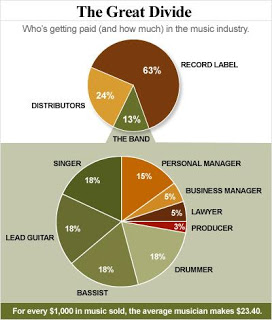 The general characteristics of some professions never seem to change much, but the specifics can mutate as dramatically as a werewolf under a full moon. Take the music industry. A recent study by BearShare shows that for every $1,000 earned, a musician takes home a paltry $23.40 in pocket change. All sorts of people take a cut of a musician’s performance in this choreographed rip-off. Record labels take a staggering 63% of the profits, for instance. In fact, musicians earn one of the smallest percentages out of everyone involved. This means a musician needs to earn a huge pile of cash for everyone involved in order to make a decent living.
Of course, the record labels are the juggernaut controlling the entire industry. Most bands don’t hit the Big Time without signing their name in blood to a record label deal down at the crossroads. These record deals affect album sales, concert dates, and many other aspects of a band’s livelihood, but the thing is, the comfort of receiving a record deal doesn’t necessarily provide any real peace of mind for many musicians. Popular artists like Tom Petty and Toni Braxton had to declare bankruptcy to sever themselves from terrible record contracts. Sometimes, this is the only way out.
All this should sound familiar to anyone who has followed the music industry over the past several decades, but it’s worth repeating. Now, on the other hand, the particulars required to earn a successful American musical career have morphed into something very different than what they used to be. In the past, radio plays determined a group’s popularity. Getting radio play meant that the band had ascended to the next level of wealth and fame. However, radio plays no longer determine success. Many popular bands survive, especially in the Alternative, Metal, Jazz, and Hardcore genres, without any radio play at all.
This isn’t because people don’t know about these bands. Metal fans are as loyal as it gets. Here’s the problem — radio no longer exists to provide the newest, hottest music to the masses. In fact, since a vast majority of stations only exist to make money instead of providing the musical variety which people deserve, stations today only play music that stays within their comfort zone. This guarantees them the maximum amount of profits but provides little assistance to talented musicians who may be struggling. How many more times do we have to listen to Nicki Minaj and Lil Wayne? Where are the talented, up-and-coming bands and soloists who can share visionary, electifying new music with us? You won’t hear them on most radio stations, that’s for sure.
 As the radio becomes an utterly inaccessible medium for many genres, bands have turned to the Internet to promote their work. Places like YouTube, Spotify, Soundcloud, Pandora, and many others have become the only way musicians can reach out to their fans. These sites can direct listeners to official band websites, Facebook, Twitter, and any other social networking places where musicians sell their albums and promote tour dates. These are the electronic mosh pits of the digital age. They’re the places that still breed community, rebellion, and innovation.
Other technology has had an equally influential effect on music listeners. iTunes, a media library application created by Apple, has been a heavy hitter for a while, now. Many people like a limited number of songs on an album, so through iTunes, Apple made it possible to pick and choose which songs a person can purchase. According to Nielsen Sound-Scan’s mid-year 2012 report, in the Rock genre, album sales increased by a meager 0.2 percent while individual songs jumped 11 percent from the previous year. Nowadays, one single can make or break a band. Very few people seem to be interested in listening to an entire album from beginning to end anymore.
With the world turning to singles, the market has become more cutthroat. Bands can’t afford to release even a single song that might receive intense criticism, warranted or not. In a recent article published in Guitar World, some well-known rock bands such as Nickelback, Stone Sour, and Halestorm talk about what it takes to stay successful as a rock musician. Chad Kroeger, the lead singer of Nickelback, states, “I honestly just think that with not just every album but every song that you release, you have to keep winning your own fans over and over again.” He refers to the way his band creates every song as meticulously as the last. He realizes that just one unpopular song can destroy his career.